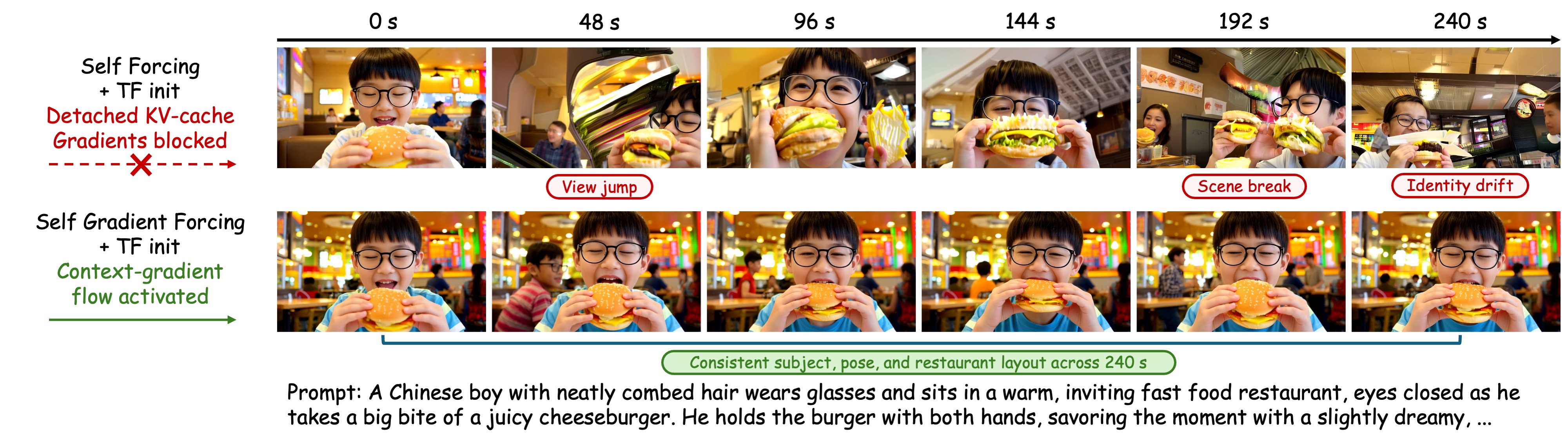
TL;DR —Self Gradient Forcing (SGF) recovers the missing context-gradient path for self-generated causal memory through a bounded two-pass replay, enabling models trained with only a
5-second window to extrapolate to minute-scale videos with stronger identity, layout, and temporal stability.
Recent autoregressive video diffusion methods are increasingly built upon Self Forcing, where the student is
trained on histories produced by its own rollout rather than ground-truth video contexts. This reduces exposure bias,
but the historical key-value cache is still used by future frames only as frozen rollout state. As a
result, future losses cannot supervise how earlier generated latents should be written into more useful keys and
values for later video-latent generation. We call this the
historical context-gradient gap. We propose
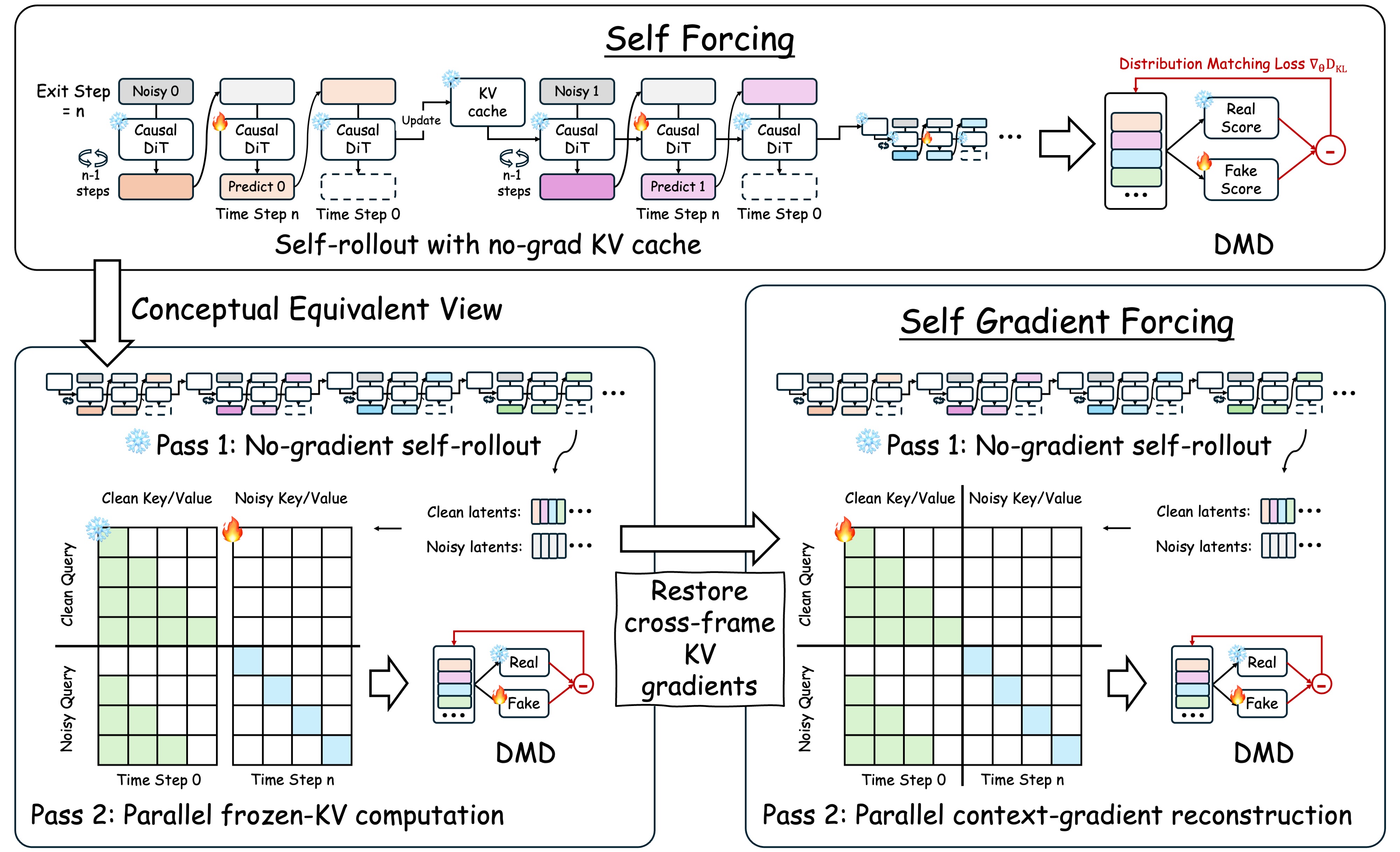
Self Gradient Forcing (SGF), a two-pass training strategy that restores this
missing supervision signal without backpropagating through the full serial rollout. Pass 1 performs a no-gradient
autoregressive rollout matching inference and, at a sampled denoising exit step, records both the self-generated
context and the noisy latents fed to the model. Pass 2 performs parallel context-gradient
reconstruction for the recorded exit step: the generated context is used as stop-gradient clean-latent
input, while the model recomputes the context KV representations and future-to-context causal attention. Thus, SGF
provides the missing memory-writing supervision within the native autoregressive training objective, using losses on
future video latents to train the model to encode context into more effective causal memory. Across extensive
long-horizon frame-wise and chunk-wise experiments under different initializations, SGF achieves stronger native
long-video extrapolation than Self Forcing, especially in subject identity, background/layout consistency, and
temporal stability. Remarkably, using only a 5-second training window, SGF can extrapolate to
videos lasting several minutes.
Method
Self Forcing trains on self-generated histories but treats historical K/V entries as detached cache state.
SGF keeps the no-gradient rollout unchanged and adds a parallel reconstruction pass, where detached context latents are re-encoded at the clean context timestep so future DMD losses supervise K/V writing without serial rollout backpropagation.
Figure 1: From frozen-cache Self Forcing to Self Gradient Forcing.
Chunk-wise Long-Horizon Generation
Four-way comparison per sample — SGF (Ours), Self Forcing (SF),
SF + Bi-directional ODE, SF + Causal ODE.
All four tiles play in lock-step; use the controls on the SGF (Ours) tile to play, pause, or scrub.
Pick a duration, then switch the AR / CD initialization.
60s Chunk-wise Long Video
240s Chunk-wise Long Video
Frame-wise Long-Horizon Generation
Two-way lock-step comparison per sample: SGF (Ours) vs Self Forcing.
The SGF (Ours) tile carries the video controls; the Self Forcing tile follows it in play, pause, and scrub.
Pick a duration, then switch the AR / CD / ODE initialization.
60s Frame-wise Long Video
240s Frame-wise Long Video
Analysis
Table 1: Training feasibility of context-gradient recovery
Direct differentiable-cache training keeps the serial cache-formation graph and runs out of memory.
SGF uses bounded parallel context-gradient reconstruction at the sampled exit step, restoring context K/V
gradients with modest peak-memory and runtime overhead.
Training variant
Peak memory
Stable memory
Time / 5 steps
Outcome
Self Forcing, frozen historical K/V cache
79.01GB
79.01GB
10.39s
trains
SGF, serial Pass 1 + parallel Pass 2
87.01GB
63.73GB
11.71s
trains
Self Forcing, differentiable historical K/V cache
OOM
OOM
--
OOM
Pass-1 / Pass-2 recovery fidelity
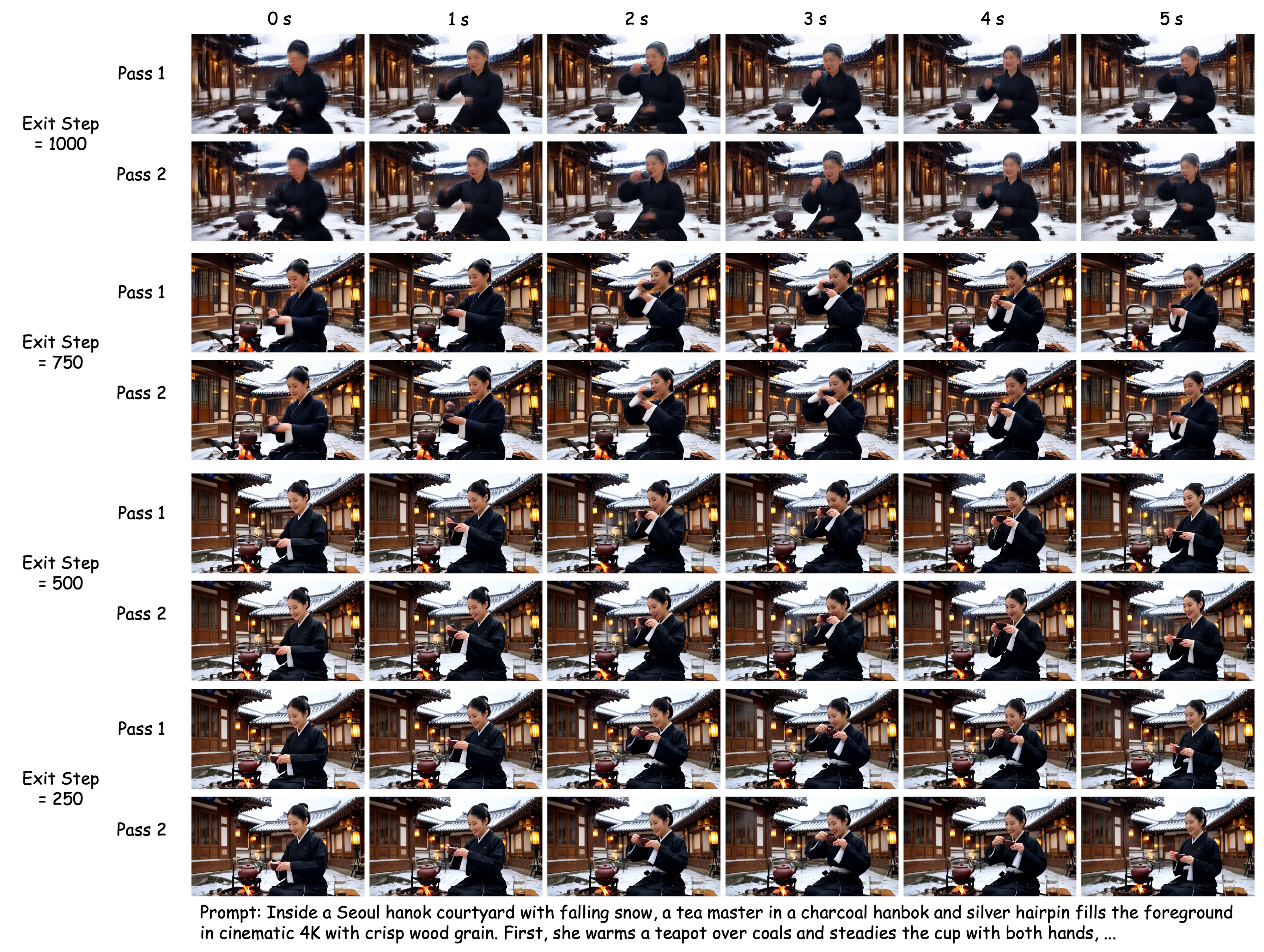
SGF relies on Pass 2 faithfully replaying the sampled exit computation from Pass 1. Figure 2
and Table 2 are the same recovery diagnostic: the decoded pairs are visually nearly indistinguishable,
while the latent metrics show low relative L2 error and near-unity cosine similarity across exit steps.
Figure 2: Decoded Pass-1 and Pass-2 recovery comparison. Rows show paired decoded outputs from Pass 1
and Pass 2 at exit steps 1000, 750, 500, and 250; the decoded pairs are visually nearly indistinguishable,
matching the latent-space recovery results in Table 2.
Table 2: Pass-1 versus Pass-2 latent recovery fidelity
Metrics are averaged over 24 prompts for each exit step. Overall averages are computed over all 96
prompt/exit comparisons. We also report the relative L2 error normalized by the bf16 relative precision
εbf16 = 2-7.
Exit step
# comparisons
MSE
RMSE
Mean abs.
Max abs.
Rel. L2
Rel. L2 / εbf16
Cosine
1000
24
3.123e-4
0.01745
0.01093
0.58396
0.02133
2.73
0.999766
750
24
2.148e-4
0.01449
0.00884
0.58189
0.01566
2.00
0.999874
500
24
1.141e-4
0.01064
0.00693
0.49110
0.01125
1.44
0.999936
250
24
6.041e-5
0.00774
0.00535
0.29028
0.00812
1.04
0.999967
Overall
96
1.754e-4
0.01258
0.00801
0.48681
0.01409
1.80
0.999886
SGF in Practice
Recent systems that explicitly use Self Gradient Forcing in their causal training pipelines.
EchoWM: Open and Enterable Omnimodal World Models
EchoWM uses Short-Horizon and Long-Horizon Audio-Visual Self-Gradient Forcing
on self-generated rollouts, enabling stable long-horizon streaming audio-visual generation with a causal
few-step generator.
XPACE: Joint World and Action Modeling from Heterogeneous Experience
XPACE uses chunk-wise Self Gradient Forcing in Stage III-sim to adapt its simulator to self-generated visual context before synthesizing recovery trajectories for policy improvement.
EdenLive: Real-Time Generative Rendering from Any Visual Reference
EdenLive follows Self Gradient Forcing's rollout–replay formulation for few-step distillation, replaying detached autoregressive rollouts in a differentiable teacher-forcing pass to train its streaming generative renderer.
@article{zhuang2026self,
  title   = {Self Gradient Forcing: Native Long Video Extrapolation},
  author  = {Zhuang, Junhao and Zhang, Shiyi and Bian, Yuxuan
             and Li, Yaowei and Luo, Yawen and Liu, Yijun
             and Jin, Weiyang and Zhang, Songchun and He, Xianglong
             and Zhang, Xuying and others},
  journal = {arXiv preprint arXiv:2607.20368},
  year    = {2026}
}